


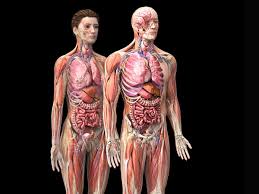
Human Anatomy

Instructor
About This Course
1. Levels of Organization
To understand the human body, anatomists look at it through a hierarchy of complexity. Each level builds upon the one below it:
Chemical Level: Atoms (like carbon and oxygen) combine to form molecules (like water and DNA).
Cellular Level: The basic functional unit of life.
Tissue Level: Groups of similar cells working together (e.g., muscle tissue, nervous tissue).
Organ Level: Different types of tissues joining to perform a specific function (e.g., the heart or stomach).
Organ System Level: Groups of organs that coordinate to meet a major physiological need.
Organism Level: The highest level—the human being as a whole.
2. The 11 Major Organ Systems
The body is divided into 11 primary systems, each with a specialized role in maintaining life and health:
| System | Primary Organs | Main Function |
| Integumentary | Skin, hair, nails | Protection, temperature regulation. |
| Skeletal | Bones, cartilage, joints | Support, protection, blood cell production. |
| Muscular | Skeletal muscles, tendons | Movement and heat production. |
| Nervous | Brain, spinal cord, nerves | Fast-acting control and communication. |
| Endocrine | Glands (pituitary, thyroid, etc.) | Long-term regulation via hormones. |
| Cardiovascular | Heart, blood vessels | Transporting oxygen and nutrients. |
| Lymphatic | Lymph nodes, spleen, thymus | Immunity and fluid balance. |
| Respiratory | Lungs, trachea, nasal cavity | Gas exchange (O2 in, CO2 out). |
| Digestive | Stomach, intestines, liver | Breaking down food and absorbing nutrients. |
| Urinary | Kidneys, bladder, urethra | Waste excretion and water balance. |
| Reproductive | Ovaries/Testes, uterus/Penis | Production of offspring. |
3. Branches of Anatomy
Anatomy is typically studied through two main lenses:
Gross (Macroscopic) Anatomy: The study of structures that can be seen with the naked eye. This can be approached regionally (studying the head, chest, or limbs) or systemically (studying one system at a time).
Microscopic Anatomy: The study of structures requiring a microscope. This includes cytology (the study of cells) and histology (the study of tissues).
4. Anatomical Directional Terms
To describe locations accurately, anatomists use standardized terms:
Superior/Inferior: Toward the head / Toward the feet.
Anterior/Posterior: Toward the front / Toward the back.
Medial/Lateral: Toward the midline / Toward the side.
Proximal/Distal: Closer to the trunk / Farther from the trunk (used for limbs).

Curriculum Overview
This course includes 0 modules, 0 lessons, and 0 hours of materials.
Course Specifications




Subscribe to Our Newsletter


Additional Links
Login Register Contact Certificate Validation Become Instructor About Terms and PoliciesContact IN


Reply to Comment